
 Almamu
e63f47de5b
chore: fix eof of music not repeating the audio, fixes #362
Almamu
e63f47de5b
chore: fix eof of music not repeating the audio, fixes #362
|
1 năm trước cách đây | |
|---|---|---|
| .github | 1 năm trước cách đây | |
| CMakeModules | 1 năm trước cách đây | |
| docs | 1 năm trước cách đây | |
| packaging | 1 năm trước cách đây | |
| protocols | 1 năm trước cách đây | |
| src | 1 năm trước cách đây | |
| tools | 1 năm trước cách đây | |
| .clang-format | 2 năm trước cách đây | |
| .clang-tidy | 2 năm trước cách đây | |
| .gitignore | 1 năm trước cách đây | |
| .gitmodules | 1 năm trước cách đây | |
| CMakeLists.txt | 1 năm trước cách đây | |
| LICENSE | 7 năm trước cách đây | |
| README.md | 1 năm trước cách đây |
README.md










🖼️ Linux Wallpaper Engine
Bring Wallpaper Engine-style live wallpapers to Linux! This project allows you to run animated wallpapers from Steam’s Wallpaper Engine right on your desktop.
⚠️ This is an educational project that evolved into a functional OpenGL-based wallpaper engine for Linux. Expect some limitations and quirks!
📦 System Requirements
To compile and run this, you'll need:
- OpenGL 3.3 support
- CMake
- LZ4, Zlib
- SDL2
- FFmpeg
- X11 or Wayland
- Xrandr (for X11)
- GLFW3, GLEW, GLUT, GLM
- MPV
- PulseAudio
- FFTW3
Install the required dependencies on Ubuntu/Debian-based systems:
Ubuntu 22.04
sudo apt-get update
sudo apt-get install build-essential cmake libxrandr-dev libxinerama-dev libxcursor-dev libxi-dev libgl-dev libglew-dev freeglut3-dev libsdl2-dev liblz4-dev libavcodec-dev libavformat-dev libavutil-dev libswscale-dev libxxf86vm-dev libglm-dev libglfw3-dev libmpv-dev mpv libmpv1 libpulse-dev libpulse0 libfftw3-dev
Ubuntu 24.04
sudo apt-get update
sudo apt-get install build-essential cmake libxrandr-dev libxinerama-dev libxcursor-dev libxi-dev libgl-dev libglew-dev freeglut3-dev libsdl2-dev liblz4-dev libavcodec-dev libavformat-dev libavutil-dev libswscale-dev libxxf86vm-dev libglm-dev libglfw3-dev libmpv-dev mpv libmpv2 libpulse-dev libpulse0 libfftw3-dev
🐧 Arch Linux Users
You can install this directly from the AUR using your favorite AUR helper:
yay -S linux-wallpaperengine-git
This installs the latest development version.
Note: You’ll still need assets from the official Wallpaper Engine (via Steam). See below for details.
🚀 Getting Started
1. Get Wallpaper Engine Assets
You must own and install Wallpaper Engine via Steam. This provides the required assets used by many backgrounds.
Right now the application will automatically detect everything for you as long as the official Wallpaper Engine is installed in one of these locations:
~/.steam/steam/steamapps/common
~/.local/share/Steam/steamapps/common
~/.var/app/com.valvesoftware.Steam/.local/share/Steam/steamapps/common
~/snap/steam/common/.local/share/Steam/steamapps/common
✅ If Wallpaper Engine is installed in one of these paths, the assets will be detected automatically!
❗ If Assets Aren’t Found Automatically
If the assets are not detected automatically, you'll see a message like this:
Cannot find a valid assets folder, resolved to 'assets'
You can copy the assets folder manually:
- In Steam, right-click Wallpaper Engine → Manage → Browse local files
- Copy the
assetsfolder - Paste it into the same folder where the
linux-wallpaperenginebinary is located (build/output if you followed the build instructions)
2. Build from Source
Clone the repo:
git clone --recurse-submodules https://github.com/Almamu/linux-wallpaperengine.git
cd linux-wallpaperengine
Build it:
mkdir build && cd build
cmake -DCMAKE_BUILD_TYPE='Release' ..
make
Once the build process is finished, this should create a new output folder containing the app and all the required
support files to run.
✅ Remember: Place the
assetsfolder next to the built binary if it isn’t detected automatically.
🧪 Usage
Basic syntax:
./linux-wallpaperengine [options] <background_id or path>
You can use either:
- A Steam Workshop ID (e.g.
1845706469) - A path to a background folder
🔧 Common Options
| Option | Description |
|---|---|
--silent |
Mute background audio |
--volume <val> |
Set audio volume |
--noautomute |
Don't mute when other apps play audio |
--no-audio-processing |
Disable audio reactive features |
--fps <val> |
Limit frame rate |
--window <XxYxWxH> |
Run in windowed mode with custom size/position |
--screen-root <screen> |
Set as background for specific screen |
--bg <id/path> |
Assign a background to a specific screen (use after --screen-root) |
--scaling <mode> |
Wallpaper scaling: stretch, fit, fill, or default |
--clamping <mode> |
Set texture clamping: clamp, border, repeat |
--assets-dir <path> |
Set custom path for assets |
--screenshot <file> |
Save screenshot (PNG, JPEG, BMP) |
--list-properties |
Show customizable properties of a wallpaper |
--set-property name=value |
Override a specific property |
--disable-mouse |
Disable mouse interaction |
--disable-parallax |
Disable parallax effect on backgrounds that support it |
--no-fullscreen-pause |
Prevent pausing while fullscreen apps are running |
💡 Examples
Run a background by ID
./linux-wallpaperengine 1845706469
Run a background from a folder
./linux-wallpaperengine ~/backgrounds/1845706469/
Assign backgrounds to screens with scaling
./linux-wallpaperengine \
  --scaling stretch --screen-root eDP-1 --bg 2667198601 \
  --scaling fill --screen-root HDMI-1 --bg 2667198602
Run in a window
./linux-wallpaperengine --window 0x0x1280x720 1845706469
Limit FPS to save power
./linux-wallpaperengine --fps 30 1845706469
Take a screenshot
./linux-wallpaperengine --screenshot ~/wallpaper.png 1845706469
This can be useful as output for pywal or other color systems that use images as basis to generate a set of colors to apply to your system.
View and change properties
./linux-wallpaperengine --list-properties 2370927443
The output includes all the relevant information for each of the different properties:
barcount - slider
	Description: Bar Count
	Value: 64
	Minimum value: 16
	Maximum value: 64
	Step: 1

bloom - boolean
	Description: Bloom
	Value: 0
frequency - combolist
	Description: Frequency
	Value: 2
		Posible values:
		16 -> 1
		32 -> 2
		64 -> 3

owl - boolean
	Description: Owl
	Value: 0
rain - boolean
	Description: Rain
	Value: 1
schemecolor - color
	Description: ui_browse_properties_scheme_color
	R: 0.14902 G: 0.23137 B: 0.4 A: 1
visualizer - boolean
	Description: <hr>Add Visualizer<hr>
	Value: 1
visualizercolor - color
	Description: Bar Color
	R: 0.12549 G: 0.215686 B: 0.352941 A: 1
visualizeropacity - slider
	Description: Bar Opacity
	Value: 1
	Minimum value: 0
	Maximum value: 1
	Step: 0.1

visualizerwidth - slider
	Description: Bar Spacing
	Value: 0.25
	Minimum value: 0
	Maximum value: 0.5
	Step: 0.01
Any of these values can be modified with the --set-property switch. Say you want to enable the bloom in this background, you would do so like this:
./linux-wallpaperengine --set-property bloom=1 2370927443
🧪 Wayland & X11 Support
- Wayland: Works with compositors that support
wlr-layer-shell-unstable. - X11: Requires XRandr. Use
--screen-root <screen_name>(as shown inxrandr).
⚠ For X11 users: Currently doesn't work if a compositor or desktop environment (e.g. GNOME, KDE, Nautilus) is drawing the background.
🌈 Example Backgrounds
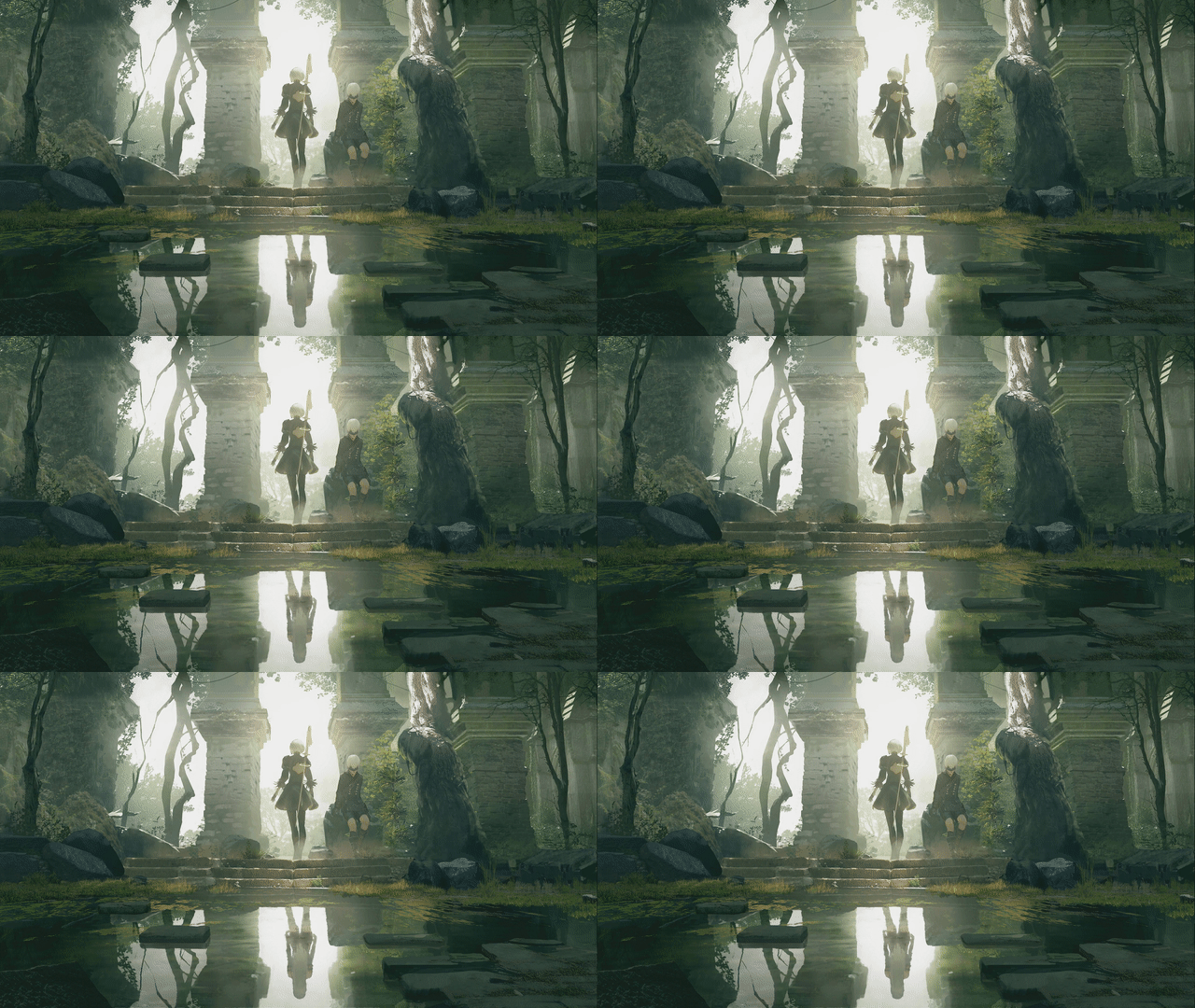
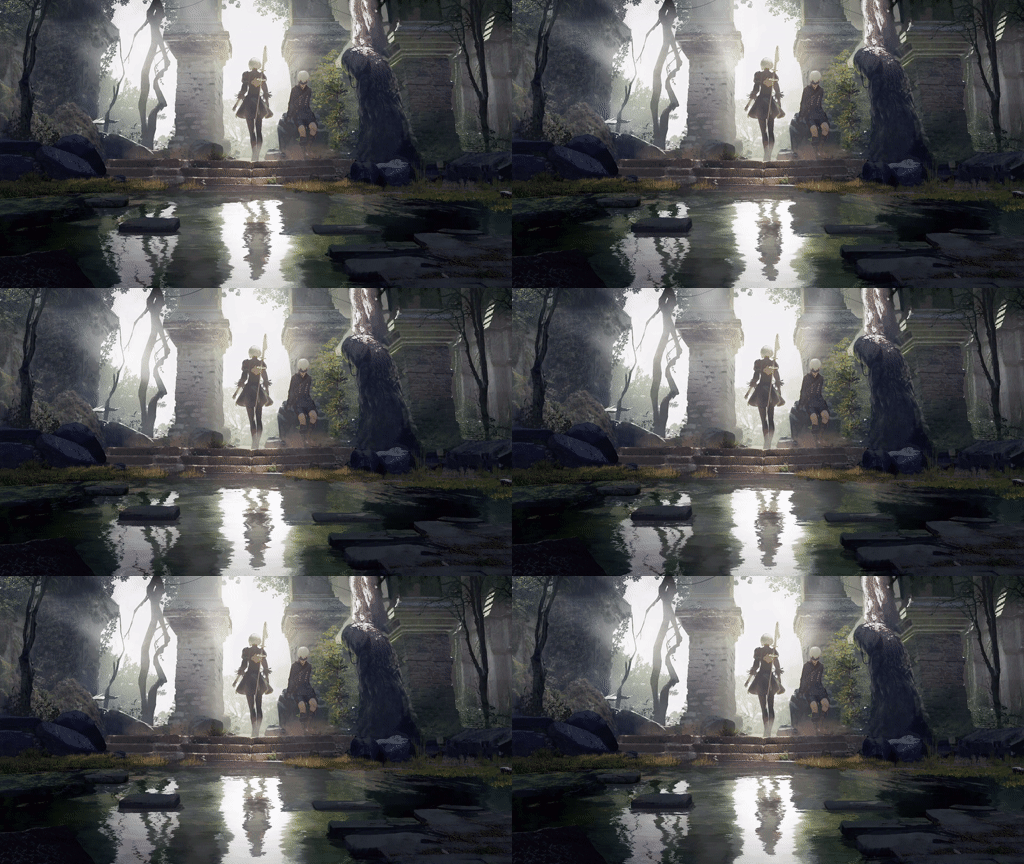
Want to see more examples of backgrounds that work? Head over to the project's website
🪲 Common issues
Black screen when setting as screen's background
This can be caused by a few different things depending on your environment and setup.
X11
Common symptom of a compositor drawing to the background which prevents Wallpaper Engine from being properly visible. The only solution currently is disabling the compositor so Wallpaper Engine can properly draw on the screen
NVIDIA
Some users have had issues with GLFW initialization and other OpenGL errors. These are generally something that's worth reporting in the issues. Sometimes adding this variable when running Wallpaper Engine helps and/or solves the issue:
__GL_THREADED_OPTIMIZATIONS=0 linux-wallpaperengine
We'll be looking at improving this in the future, but for now it can be a useful workaround.